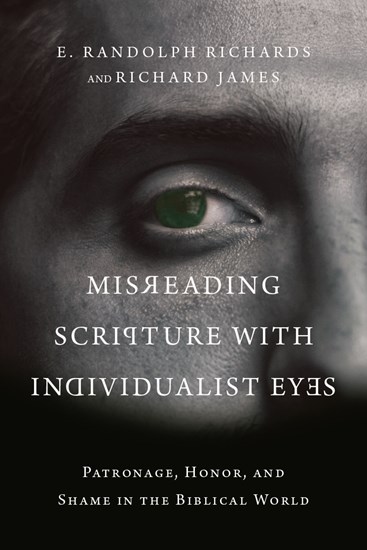
The journal Ad Fontes published my review of E. Randolph Richards and Richard James, Misreading Scripture with Individualist Eyes: Patronage, Honor, and Shame in the Biblical World (Downers Grove, IL: IVP Academic, 2020).
On balance, this book is not one that I’d recommend. Here’s an excerpt from the final paragraph of the review:
[This book’s] attempt to bridge the “understanding gap” between the individualism of the assumed reader and the collectivistic cultural context of the biblical text is successful at times. Richards and James introduce several difficult-to-grasp concepts and terms with good illustration and elaboration. But their attempt is largely unsuccessful, in my view. The unexpected weakness of [Misreading Scripture with Individualist Eyes] is its handling of Scripture. A few examples have been given throughout this review, but there are many more. Sometimes, Richards and James misread Scripture by making unverifiable assumptions about the collectivism of a biblical writer. Sometimes, they overlooked the formulations of Christian tradition in favor of novelties that either add nothing or cut against Scripture itself. And sometimes, alas, Richards and James have not paid sufficient attention to the details of the biblical text.
Because of word count, I had to cut out some of the specific examples of exegetical blunders. But I’ll include one here that illustrates the last sentence of the quote above.
Richards and James attempt a reinterpretation of the passage about Joseph and Potiphar’s wife in Gen 39. The analysis begins with a parenthetical comment that “there aren’t Ten Commandments” at the time of Joseph’s service in Potiphar’s house (15). The writers apparently seek to undermine the usual interpretation that Joseph refuses Potiphar’s wife because he wishes to avoid committing adultery. Instead, the writers suppose that Joseph—in speaking so highly of himself in Gen 39:8–9—is refusing Potiphar’s wife because he is arrogant and that his arrogance is what offends her to the point of seeking revenge. But this reasoning prioritizes the woman’s accusation, rhetorically framed with racialized us-them language (v. 14), over Joseph’s own rationale. While we cannot completely know motives, Joseph does explicitly state that Potiphar has given him everything “except” (כי אם) this wife and that for Joseph to have sex with her would constitute doing a great wickedness and sinning before God (v. 9). Looking closely at this verse, it is clear that Richard and James have misread a detail in the text: they contradict Joseph’s statement when they say that “Potiphar has put everything (including her) into Joseph’s hand” (15). Joseph clearly says that, even if everything else is in his power (cf. v. 4), the wife is not included; she is the one exception to Joseph’s authority in the house. So in Joseph’s own words, he is not intending to exalt himself above Potiphar’s wife. The issue is not arrogance, even if that is part of the rhetoric that Potiphar’s wife uses to convince the household to betray Joseph (v. 14). Furthermore, what Joseph does reveal about his motives he puts in moral and theological terms. Joseph reasons that Potiphar has withheld the woman from him precisely because she is his wife (באשר את אשתו, v. 9). Joseph seems to be aware that taking another man’s wife (i.e., adultery) is an offense against God, as if—dare I say it—the moral principles of the Ten Commandments were not invented ex nihilo at Sinai. The moral law is the appropriate backgrounds for understanding Joseph’s choice, not sociological generalizations about collectivist cultures; put another way, Joseph’s stated concern is not about Potiphar’s patronage (as the writers would have it) but about God’s judgment. This temptation passage, where Joseph is given stewardship over all but one forbidden person, is best read against the narrative-historical background of Genesis 2–3, where the first man is given free use of all the trees but one. In such a context, Joseph is presented not as an arrogant upstart who flaunts collectivist thinking but as an Adam-counterpart (and a Christ-prefiguration) who suffers unjustly for resisting this temptation.
There are several other examples that I could bring up. If anything, reading the book and reflecting on its interpretive claims sharpened my conviction that getting the covenant history right—which involves reading Scripture in light of other Scripture—is far more important than any speculation that might be brought in from the disciplines of social history.
 Mohr Perspectives
Leave a comment